
What If There’s More to Your Health Than the Problem That’s Bothering You Right Now?
“You are truly my last hope,” Kristi exclaimed, crying, as she entered my office.
On her medical history form, she wrote, “Too many symptoms to fit on one page.”
Ninety days later, Kristi no longer worried about everything. Her ADHD and dysautonomia had improved significantly. She no longer felt cold all the time, and she was able to climb her stairs again. She had come a long way—not because everything had been fixed, but because she finally had a comprehensive approach to her health.
Marc’s story was different. He had just one complaint. “I found you completely by chance. I Googled ‘stomach pain’ and found your website. I can’t believe how lucky I am! You have helped me with so much more than just my stomach pain.”
Marc had become so accustomed to feeling poorly that he hadn’t thought to ask for help with several of his other symptoms. During his evaluation, we identified several potential contributors to his health problems, including inflammatory issues associated with Lyme disease and mold exposure. Today, he is amazed by how much more energy he has.
Then there is Nicki. She came to her first appointment looking for help with macular degeneration. At her second visit five weeks later, she reported that her vision had improved—and her sleep, energy, anxiety, joint pains, bloating, belching, gas, and sugar cravings. She had also lost 14 pounds and several inches from her waist.
Three different people. Three very different reasons for seeking help. They illustrate something I have learned throughout my practice of medicine: Sometimes the problem that brings you into the office isn’t the whole story.
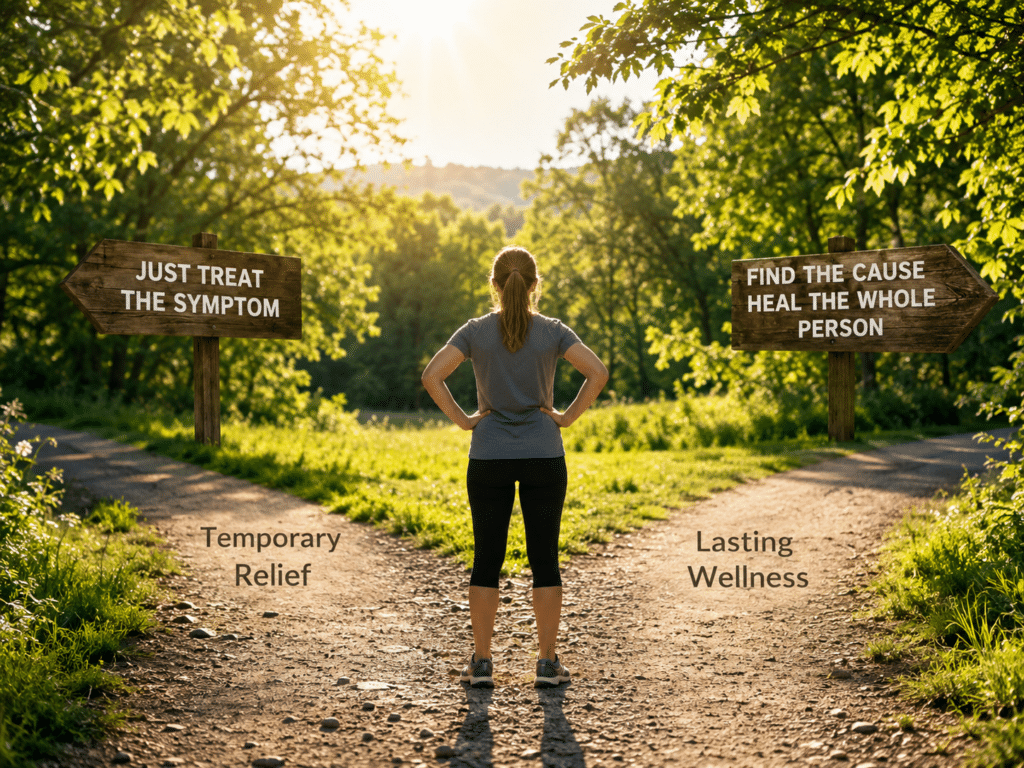
The problem you came in with—and the problems you didn’t know to ask about
When I was in residency, one of my attending physicians taught me that she permitted her patients two problems per visit: the most important one they came in with and one she was concerned about. A patient might come in with a sore throat, for example, while the doctor notices that his blood pressure is unusually high. Both issues deserve attention.
There is a practical reason conventional medical visits often work this way. When someone has an acute problem—a laceration, a sore throat, a bladder infection—the diagnosis can often be made and treated relatively quickly.
But what happens when a person doesn’t have one problem? What happens when there are 10, 20, or 50 symptoms? What happens when the symptoms have gradually accumulated over years, until the person simply thinks, This is just how I am now? Trying to address each symptom independently can become frustrating for both the patient and the physician.
At Prestige Wellness Institute, we take a different approach. Rather than beginning with each symptom and looking for a corresponding treatment, we step back and look at the bigger picture.
What symptoms are you experiencing? What does your sleep look like? Your nutrition? Your stress? Your energy? Are there nutritional deficiencies or hormonal imbalances that may be contributing to how you feel? Are there infections, environmental exposures, or other factors worth investigating? How is your nervous system functioning?
The goal isn’t simply to collect diagnoses. The goal is to understand the person behind the symptoms.
Our five-part framework
After nearly three decades of helping people regain their health, we have developed a framework that guides our approach:
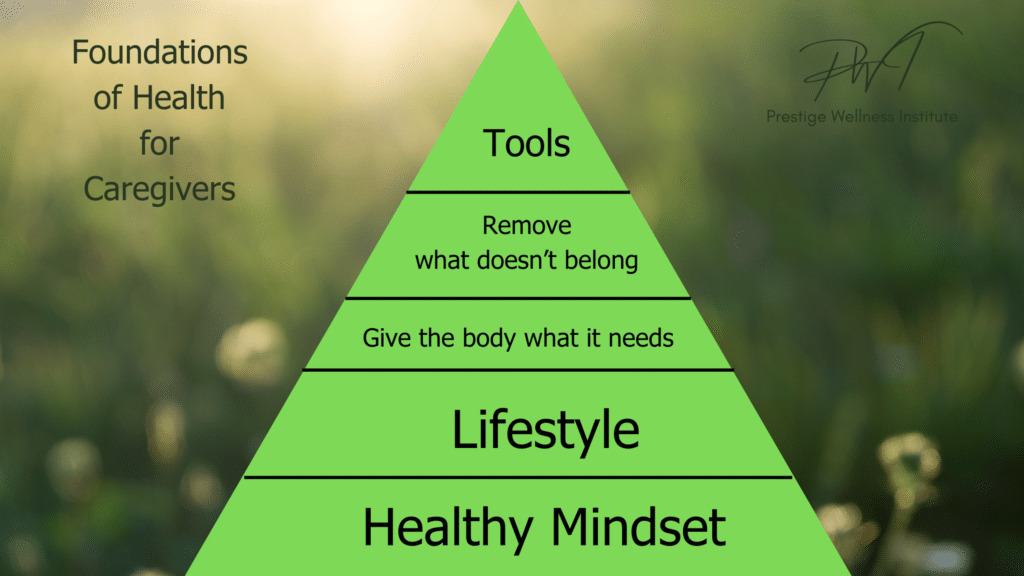
1. Start with mindset—especially hope.
It is difficult to move forward when you’ve lost hope.
Mindset isn’t about pretending everything is fine or believing that positive thinking can cure disease. It is about having enough hope and purpose to take the next step.
We don’t pursue health simply for the sake of having better lab numbers. We pursue health because of what better health allows us to do. For Kristi, that meant having the energy to enjoy her grandchildren. And hope can grow through small victories. Her first phone call, each office visit, follow-up conversations, and the improvements she began experiencing all helped reinforce the belief that change was possible.
2. Add a healthy lifestyle.
Health doesn’t come from positive thinking alone—and it doesn’t come from a bottle of pills, either. Lifestyle matters. This includes individualized nutrition, appropriate physical activity, restorative sleep, and strategies for managing stress. These aren’t glamorous interventions, but they form the foundation upon which everything else is built.
3. Give the body what it needs.
Our bodies require vitamins, minerals, essential nutrients, and properly balanced hormones to function well. But everyone’s needs are different. Rather than assuming that everyone needs the same supplements, we use appropriate testing and clinical evaluation to help identify potential nutritional deficiencies and hormonal imbalances. The goal is personalization—not simply taking more pills.
4. Identify and remove what may be getting in the way.
The body needs more than adequate nutrition.
It also needs an environment in which its normal processes can function properly.
Depending on the individual, that may mean investigating infections, environmental exposures, or other factors that could be contributing to symptoms and inflammation.
Appropriate testing can help determine which possibilities deserve attention.
5. Use tools that support the body’s natural processes.
Modern healthcare gives us an expanding collection of tools. Some are simple and time-tested, such as botanical and Chinese herbal therapies. Others involve sophisticated technology and newer approaches. We also use various types of injections and other therapies when appropriate. The point is to use the right tool for the right person at the right time—with the goal of supporting the body’s ability to function and recover.
You don’t have to wait until you’re completely broken
One of the most rewarding parts of this work is seeing someone regain abilities they had assumed were gone forever. Maybe it’s climbing the stairs again. Maybe it’s having enough energy to play with the grandchildren. Maybe it’s sleeping through the night. Maybe it’s simply waking up and realizing you don’t feel terrible anymore.
Some people come to us for help with a specific diagnosis. Others come because they have a collection of symptoms nobody has been able to figure out. Still others, like Marc, come in for one problem and discover they have several other issues worth addressing.
If you’ve been living with nagging symptoms that don’t go away—or if you’ve gotten used to feeling less energetic and capable than you used to—perhaps it’s worth asking a different question: What if there is more to the story?
At Prestige Wellness Institute, our approach is to look at the whole person, identify factors that may be interfering with health, and develop a personalized plan for moving forward.
You don’t have to wait until you’re completely broken to start paying attention to your health. If you’re wondering whether this approach might be appropriate for you, call Prestige Wellness Institute at 435-210-0184 in Utah County or 435-259-4466 in Moab.