
As a medical student in the 1990s, I remember sitting in the library reading a major American medical journal devoted entirely to nutritional supplements.
I was excited. Finally, I thought, mainstream medicine was taking vitamins and minerals seriously.
The excitement didn’t last long.
Study after study seemed to conclude that supplements were ineffective, unnecessary, or even dangerous. The message was clear: save your money, eat a balanced diet, and get your nutrients from food.
But as I read more carefully, something didn’t make sense.
One study, for example, found that taking 400 IU of vitamin D2 for one year did not reduce heart attacks compared to placebo. Fair enough. That’s what the study showed.
But the conclusion presented to readers was much broader: Vitamin D does not prevent heart disease.
There’s an important difference between those statements.
The study evaluated one form of vitamin D, at one dose, for one period of time. Yet the conclusion was applied to vitamin D as a whole.
As a medical student, I didn’t consider myself qualified to challenge established researchers. But even then, it seemed obvious that the dose, the form, the population studied, and the length of treatment all matter.
Unfortunately, many people came away with a simple message: Supplements don’t work. Just eat healthy.
The problem is that our food supply isn’t what it once was.
They Don’t Make Them Like They Used To
Many fruits and vegetables today contain lower levels of certain minerals than they did decades ago. USDA data has documented declines in several nutrients in commonly consumed foods.
Several factors contribute to this:
- Soil depletion
- Monocropping
- Erosion
- Heavy reliance on synthetic fertilizers
- Modern agricultural practices
Some research also suggests that pesticide use may reduce certain protective plant compounds. Plants naturally produce antioxidants to defend themselves from environmental stress, insects, and disease. When these stresses are reduced, some of those compounds may also decline.
Even people who eat exceptionally healthy diets may not obtain the same nutrient levels that previous generations received.
How Do You Know If You’re Deficient?
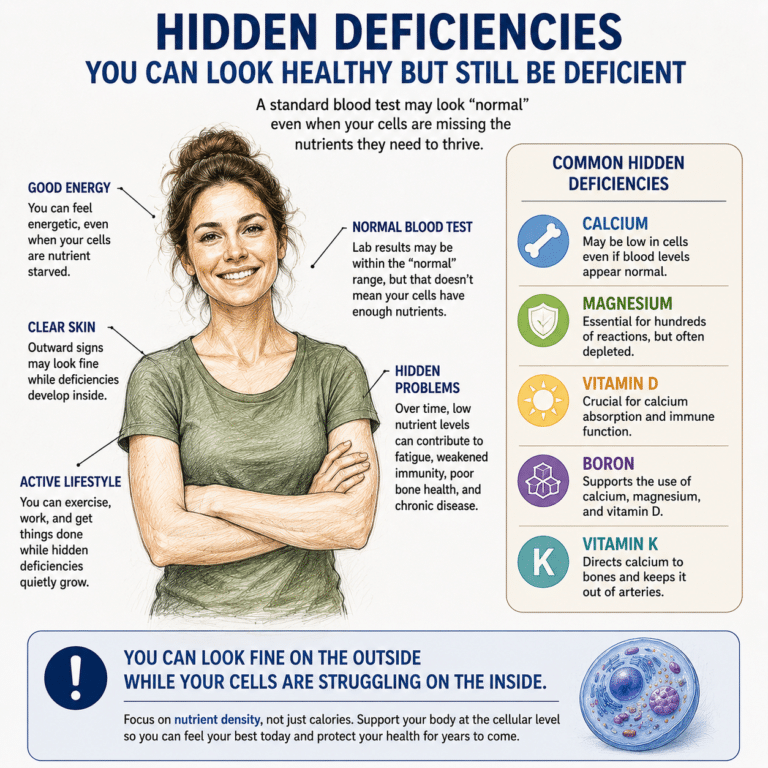
Most people assume that blood tests provide the answer.
Unfortunately, mineral testing is often more complicated than that.
Take magnesium as an example. Only a small percentage of the body’s magnesium is found in the bloodstream. Most of it resides inside cells, bones, muscles, and nerves.
Your blood level may appear perfectly normal while your tissues are running low.
The body also works very hard to keep blood levels within a narrow range. If blood calcium or magnesium levels fall too low, serious problems can occur, including heart rhythm abnormalities.
To prevent this, the body may pull minerals out of bones, muscles, and other tissues to keep blood levels normal.
As a result, a blood test can sometimes suggest everything is fine while the body’s reserves are gradually being depleted.
Laboratory reference ranges create another challenge. These ranges are designed primarily to identify dangerous abnormalities. They tell us whether you’re likely to be critically deficient or excessively high.
They do not necessarily tell us whether your levels are optimal.
Looking Beyond Blood Tests
For this reason, some practitioners use Hair Tissue Mineral Analysis (HTMA), which measures minerals deposited in growing hair over time.
HTMA is not intended to replace all blood testing, but it may provide additional information about long-term mineral patterns and mineral relationships within the body.
Questions such as:
- Is sodium truly excessive?
- Is calcium actually low?
- Are magnesium levels adequate?
- Are certain minerals interfering with others?
can be explored through this type of testing.
When Something Is Low, the Answer Isn’t Always More
One of the biggest mistakes in medicine is assuming that a low level automatically means you should take more of that nutrient.
The body functions as an interconnected system.
For example, calcium metabolism depends upon magnesium, vitamin D, vitamin K, boron, stomach acid, and healthy digestive function. A person may appear low in calcium, but the real issue may be poor absorption or an imbalance elsewhere.
Likewise, medications such as acid-blocking drugs can interfere with the absorption of multiple minerals.
Simply adding more of a nutrient doesn’t always solve the problem.
Sometimes the question isn’t, What are you missing?
It’s, Why are you missing it?
The Bottom Line
- Modern foods contain fewer nutrients than foods of previous generations.
- Blood tests do not always reflect what is happening inside the cells and tissues.
- One-size-fits-all multivitamins fit nobody. You may not need any of a certain nutrient in that multivitamin while needing much more of another. Targeted nutritional supplementation is a better approach.
- Understanding the relationships between nutrients often matters more than simply taking more of one vitamin or mineral.
Good nutrition remains the foundation of health.
But in today’s world, “eat healthy” may not always be enough.
If you have ongoing fatigue, muscle cramps, poor sleep, low energy, headaches, osteoporosis, or other unexplained symptoms, a more comprehensive evaluation of nutritional status may provide useful answers.
At Prestige Wellness Institute, we help patients take an evidence-informed approach to nutrition and mineral balance so they can make decisions based on their individual needs rather than guesswork. In a world where our food, soils, and lifestyles have changed dramatically, understanding your body’s nutritional needs may be one of the most important investments you can make in your long-term health.
If you need help sorting out what your true needs are, or why your body isn’t working the way you deserve it to, call (435) 259-4466 in Southeastern Utah or (435) 210-0184 in Northern Utah.